
Clayton County Bench Warrants Explained
People say bench warrant. Iowa's paperwork says arrest warrant for failure to appear, so match that phrase when reading a Clayton County docket. Under Iowa Code section 805.5, a citation directs a person to appear in court. A willful miss changes things. The court may issue an arrest warrant. It can also treat the failure as a simple misdemeanor. Whether the miss was willful and whether a warrant issued are facts of the case, not assumptions. A missed date alone proves neither. The judge still has to act on it. Contempt, probation, civil proceedings, and unpaid court debt follow other procedures, so a Clayton County search works best with the exact case type and event label.
Clayton County Uses Iowa FTA Terms
Iowa skips the old terms. No Clayton County docket will say capias or capias pro fine; those names belong to other states. Importing them can steer you to the wrong form or office. So read the docket's own words: failure to appear, arrest warrant, returned, served, or recalled.
- Failure to appear
- A person does not attend a required setting; the court still must decide what follows.
- Recall
- The court withdraws its warrant through a new order.
- Quash
- The court sets aside the warrant or process.
- Return
- A peace officer reports what happened with the warrant.
- Bond
- Case-specific money or release conditions set to help ensure appearance.
Plain words keep a Clayton County bench warrant search honest. They tie the check to the record, not to a label.
How Clayton County Bench Warrants Are Issued
The sequence starts simple. A citation sets a required court date in a Clayton County case. Miss it willfully, and the court issues an arrest warrant. The clerk then forwards that warrant, with the original or electronic citation, to the issuing agency's docket for enforcement. An arrest brings the person back to court. There, the original matter and the failure-to-appear matter may be heard together. That sequence predicts nothing about one case. A judge may have set a new date. The warrant may have been recalled, or it may never have issued at all. Search Iowa Courts Online for the dated event. Then call the Clayton County clerk before assuming anything. Do not wait for an assumed expiration; no Iowa rule ends a bench warrant after a fixed number of days.
After a Missed Clayton County Date
Act fast after a missed date. Dig out the citation or case ID, confirm which county filed it, and read every event after the missed setting. Then call the Clayton County clerk. Ask whether the docket shows an FTA or warrant, whether a new hearing is set, and what official step puts the matter back before the court.
Myth and fact: Missing court can lead to a warrant, but the missed date itself is not proof that a judge issued one.
The clerk may send you to law enforcement. Then call the Clayton County Sheriff directly. Skip the anonymous crime-tip form for questions about your own record; it is not monitored around the clock and exists for tips, not case-status answers.
Bench Warrants and Arrest Warrants Compared
Both papers can authorize an arrest. Their starting points differ. A Clayton County bench warrant grows out of an existing case, usually after a missed duty. A new arrest warrant comes when a judicial officer finds legal cause in a complaint or probable-cause material.
| Feature | Bench or FTA warrant | New arrest warrant |
|---|---|---|
| Trigger | Willful failure to appear or court noncompliance | Probable cause tied to an offense |
| Case posture | Usually an existing citation or case | May begin or advance a criminal case |
| Issuer | Judge or magistrate acting in the case | Magistrate or judge on legal support |
| Public clue | FTA, issue, recall, hearing, or return event | Complaint, issue, arrest, return, or bond event |
| Next step | Ask the issuing court about recall or appearance | Ask counsel, court, and sheriff about lawful surrender |
In Clayton County, whichever agency serves the paper, only the court can order it recalled.
Clayton County FTA Record Fields
A safe example uses fictional data. It shows the sequence of a Clayton County record rather than a private person, and the useful fields tie the missed date to the judge's action and the later status.
| Case or citation | A fictional reference such as SMCR-000000. |
|---|---|
| Scheduled appearance | The date and type of the required setting. |
| FTA event | The court’s exact entry about nonappearance. |
| Warrant date | The date an arrest warrant was issued, if shown. |
| Issuing court | Iowa District Court in the correct filing county. |
| Conditions | Any endorsed bail or release terms for that case. |
| Latest status | Service, return, recall, new hearing, or other later event. |
No single field can carry a Clayton County warrant answer; the newest dated court event and direct confirmation govern the next step.
Resolving a Clayton County Bench Warrant
Clayton County publishes no walk-in recall calendar. There is no set surrender appointment or guaranteed release process either. Fixing a bench warrant can mean an appearance, a court order, bond or release conditions, allowed payment, or a motion filed by counsel. The docket decides the route.
- Identify the case, citation, filing county, missed date, and issuing court.
- Call the clerk and ask what the docket says and whether a hearing is set.
- Consult a licensed Iowa attorney about appearance, recall, quash, or bond.
- Call sheriff dispatch or administration if the clerk directs enforcement confirmation.
- After action, keep the order and receipt and confirm the latest court status.
Caution: Do not arrive expecting same-day release or pay an unknown caller; follow case-specific directions from the court, sheriff, and counsel.
The Clayton County warrant records overview covers other warrant types in more depth.
Clayton County Payment and Recall
Paying court debt does not prove a recall. Iowa's Pay a Fine page warns that online payment is a guilty plea. If the citation says court appearance required, the page says to appear instead. Court debt is generally due 30 days after assessment. A Clayton County clerk can discuss a payment plan. At an appearance, a judge may set a plan with a minimum $50 payment. That is not a universal warrant-clearing formula, in Clayton County or elsewhere. Ask whether a judge entered a recall order. Also ask whether a new date or other condition remains. Keep the payment receipt, and keep the court order or the clerk's dated confirmation too, since the public docket can lag behind a case event.
Finding the Court That Issued the Warrant
Iowa runs one unified trial-court system, so Clayton County has no separate modern municipal criminal court. The layers all sit inside the county courthouse. Judicial magistrates handle scheduled violations, simple misdemeanors, county and municipal infractions, preliminary hearings, warrant proceedings, arrests, and bail. District associate judges add serious and aggravated misdemeanors plus certain felonies. District judges hold general trial jurisdiction. Start with the Clerk of District Court, 111 High Street NE, Suite 203, Elkader, IA 52043. Call 563-245-2204 on weekdays between 8:00 a.m. and 4:00 p.m. Case number, hearing, FTA, copy, and payment questions all begin there. The sheriff, at 563-245-2422, routes warrant service. City police can point an agency question the right way, while city clerks stick to administration and parking rather than any separate criminal docket.
Clayton County Records Request Route
When the public docket is thin, the Clayton County records request form lets you ask for existing releasable agency records. The county site shows the form.
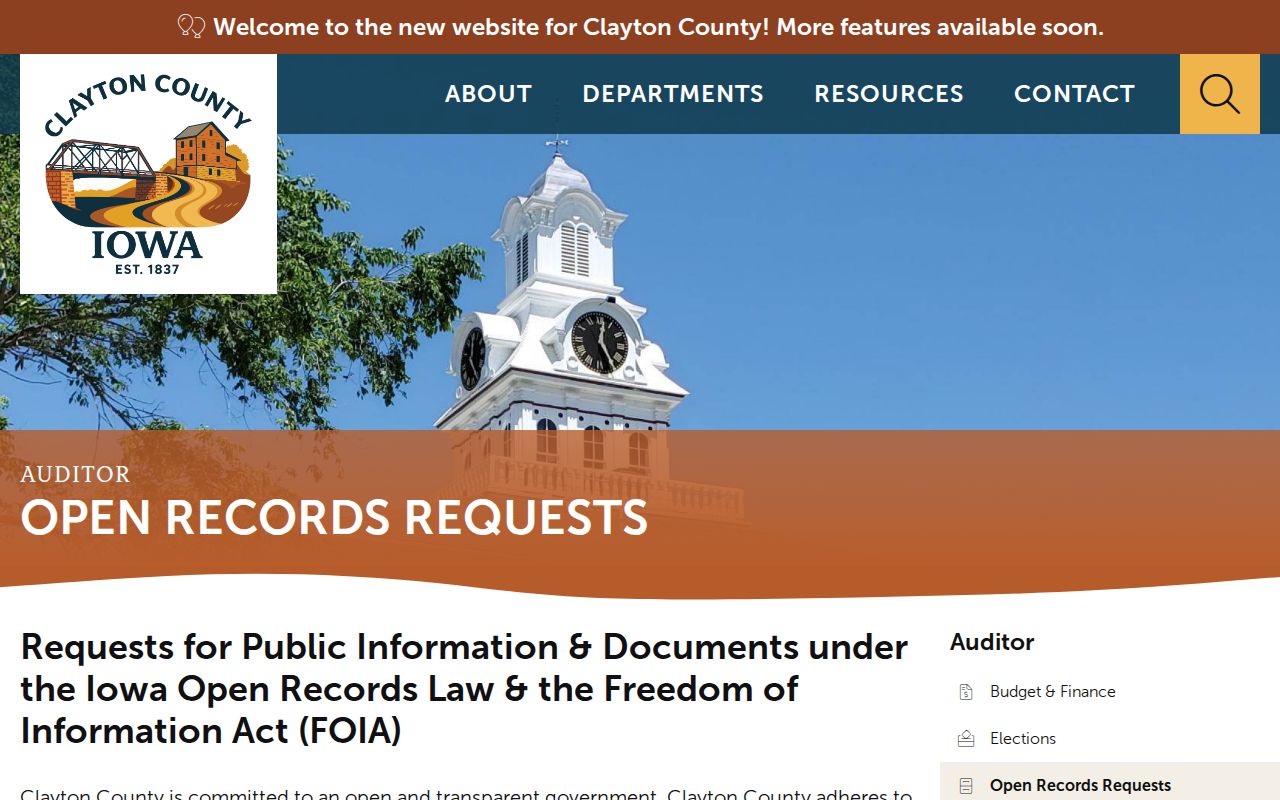
Name the case or citation, the date range, and the issuing office. Say which event you want, such as issuance, service, return, or recall. Ask for electronic records if available. Clayton County may charge actual retrieval, review, supervision, and copying costs, with advance payment possible when the estimate exceeds $50, and confidential material may be redacted or withheld.
Clayton County Bench Warrants Travel
Under Iowa Code section 804.4, a warrant goes to a peace officer and can be served in any Iowa county. Distance does not blunt it. A warrant issued elsewhere can therefore follow someone who lives in Clayton County. Postville complicates things. The city straddles Clayton and Allamakee counties. Search by the filing county, not residence alone. If the county is unclear, read the citation, case ID, police agency, and docket heading. Then contact the clerk of the county holding the case, because a blank Clayton County bench warrant search says nothing about an Allamakee matter. Federal process is separate. It runs through the Northern District of Iowa rather than the state portal.
Clayton County Juvenile Access Limits
Juvenile Court sits inside Iowa District Court, but juvenile records can be confidential under Iowa Code chapter 232. The adult public-search route is the wrong tool. Never use it to seek or publish a child's name or docket details. A parent, guardian, authorized person, or lawyer should contact the court or juvenile office instead, since a restricted route exists for them. Sealed and investigative material gets the same care. Public access has legal bounds. Iowa Courts Online may show nothing. That blank does not prove no record exists, and no Clayton County office should be pushed to release information the law protects.